Defending The Historic(?) Christian Faith

Introduction After numerous faculty and alumni from Southern Evangelical Seminary became Catholic, the school finally offered a class on Roman Catholicism being taught by Norman Geisler at Southern Evangelical Seminary. Given that so many of his associates and students have become Catholic over the years (including the co-author of his latest book on the subject!), this was not…
What is “Full Communion With the Catholic Church”?

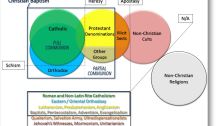
Introduction When people become Catholic they often describe it as “coming into full communion with the Catholic Church.” That might sound like an obtuse description of the event, but it is actually both accurate and important in its details. This is because Catholics consider all validly baptized Christians to be “in the Church” even if…

The Protestant’s Burden

Introduction For 500 years now, Protestants have been arguing that Catholicism is a false (or at least an extremely faulty) version of Christianity. After entering into this debate more deeply over the last couple years, I noticed some trends in the debate and also came up with a thought experiment I’d like to share. I wondered what it…

How to Argue with Catholics

Introduction There are some logical fallacies that occur often enough to be given names. Some sound humorous, like “Arguing Against a Strawman” (which is when an opponent’s position is misrepresented and then attacked). Others have titles that have been distorted by pop culture, like “Begging the Question” (which refers to an argument that assumes its…

Can the Grammatical-Historical Method of Interpretation Determine Christian Orthodoxy?

Introduction In a previous post I argued that Norman Geisler’s inclusion of the Grammatical-Historical Method [GHM] of interpretation in his “Logical Method” for discovering Christian orthodoxy was problematic. Here I will expand on this issue, for it is often at this stage that related debates get hung up. This is not a critique of the GHM itself.…

Sola Scriptura: Death by a Thousand (or Ten) Qualifications?

Introduction The doctrine of sola scriptura (“Scripture alone”) began its life as a concern for proper authority in religious matters.  By “authority” here I mean something like “that which has the right to compel agreement.” A religious authority would be one which has the right to compel faith (orthodoxy) and actions (orthopraxy). This does not…